

Project introduction
The project aimed to create a poster that critically reviews literature based on architecture and visually represents their interpretation. The poster was created by Akheel Khan, Nhlanzeko Mbatha and myself Kekelwa Akombelwa. Through a series of posters, we discussed how alternative knowledge production systems can encourage a holistic view of ecological sustainability. We also explored how liminal spaces can be represented through the use of technology and how decolonial computing can lead to a more inclusive architecture. We even delved into what African architecture could potentially look like if it was colonized. Decoloniality was explored as the act of not being colonized.
The poster design
When it came to the poster design, we looked at what a decolonial presentation would be like and for us it would be a hybrid between conventional and unconventional. The poster is inverted to allow focus on the fabric that is holding the information together and not only the images. It was noted that the cosmos, rhythms and patterns found in African traditional cultures are a common theme. The theme of circular elements is represented with the spiral that is reminiscent of the ordering systems that exist in the galaxy which manifest in the African continent as circular forms which give life to African architecture.
What would African architecture look like if Africa wasn’t colonized ?
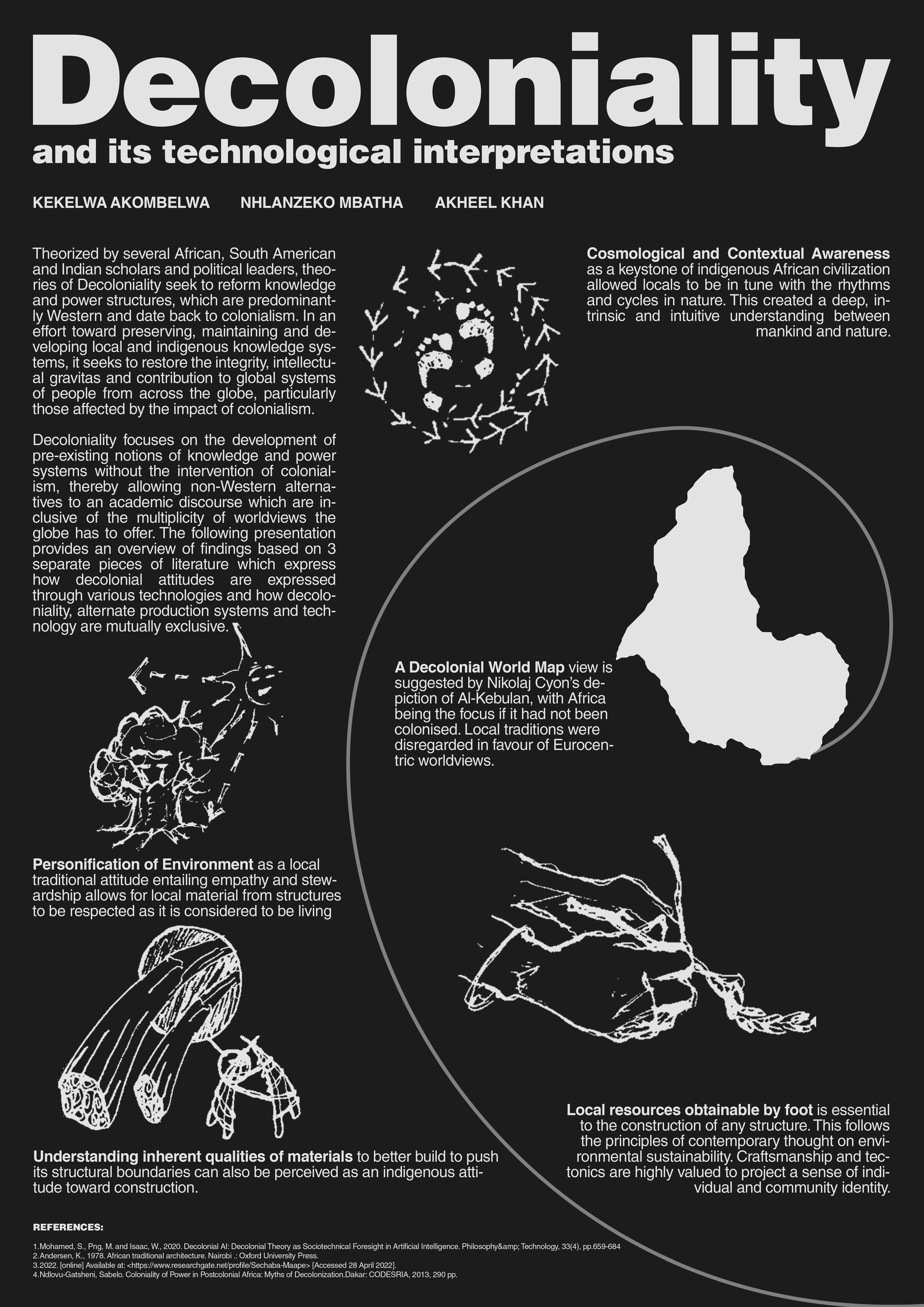
The poster introduction begins with Africa upside down which is called Al-kebulan. Al-kebulan means ” mother of mankind” and “Land of the dark-skinned people” which relates to the idea that if Africa was not colonized it would be centred on the map emphasizing the point of Africa being the genesis of mankind. The spiral along the poster represents the overlapping themes within the 3 different literature sources. The spiral also represents the circular geometry which is used in various African indigenous dwellings. The spiral is the summarized form of the circle and represents the connection with the supreme being and the origin of mankind.
Cosmological and contextual awareness, is a foundational element of indigenous African civilisation, allowing locals to be in tune with the rhythms and cycles of nature thus translating it into their vernacular architecture, this opposes Western architecture. Indigenous architecture is based off environmental personification reflecting their local traditional attitude of which entails empathy and stewardship allowing for structures constructed from local materials. Local materials are to be respected as it is considered to be living.
One may also think of an indigenous mindset towards construction as knowing the intrinsic properties of materials and using that knowledge to better construct things and push their structural limits.
Vernacular Architecture

The first literature piece we reviewed was African traditional architecture: a study of Housing and settlement patterns in Rural Kenya, which was written by Kaj Blegvad Anderson. The goal of Anderson’s work is to show how the architectural quality of Kenyan communities under pre-western and post-western technological influence differs. The book examines early Kenyan settlements. The target market is readers who tend to view African rural developments from a Eurocentric perspective, notably in Kenya.
Anderson noted that rural Kenyan building decisions seemed to come from a point of resource and survival and are executed using local materials thus maintaining a deep connection with the natural environment. The circular form of their dwellings was based on practicality as it was utilised by a single person demarcating the space, the structures were built this way so they can be easily erected and disassembled. Travel and dynamism were key influences for temporary structures to be built. Especially applicable to the nomads of Sub-Saharan Africa.
Therefore is can be said that building skills and craftsmanship were locally sourced whereas today these are sourced based on economics and cost-effectiveness. Pre-colonization building methods supported the architecture and today modern building methods compromise the architecture in rural settlements.
The Architecture of Spiritual Places
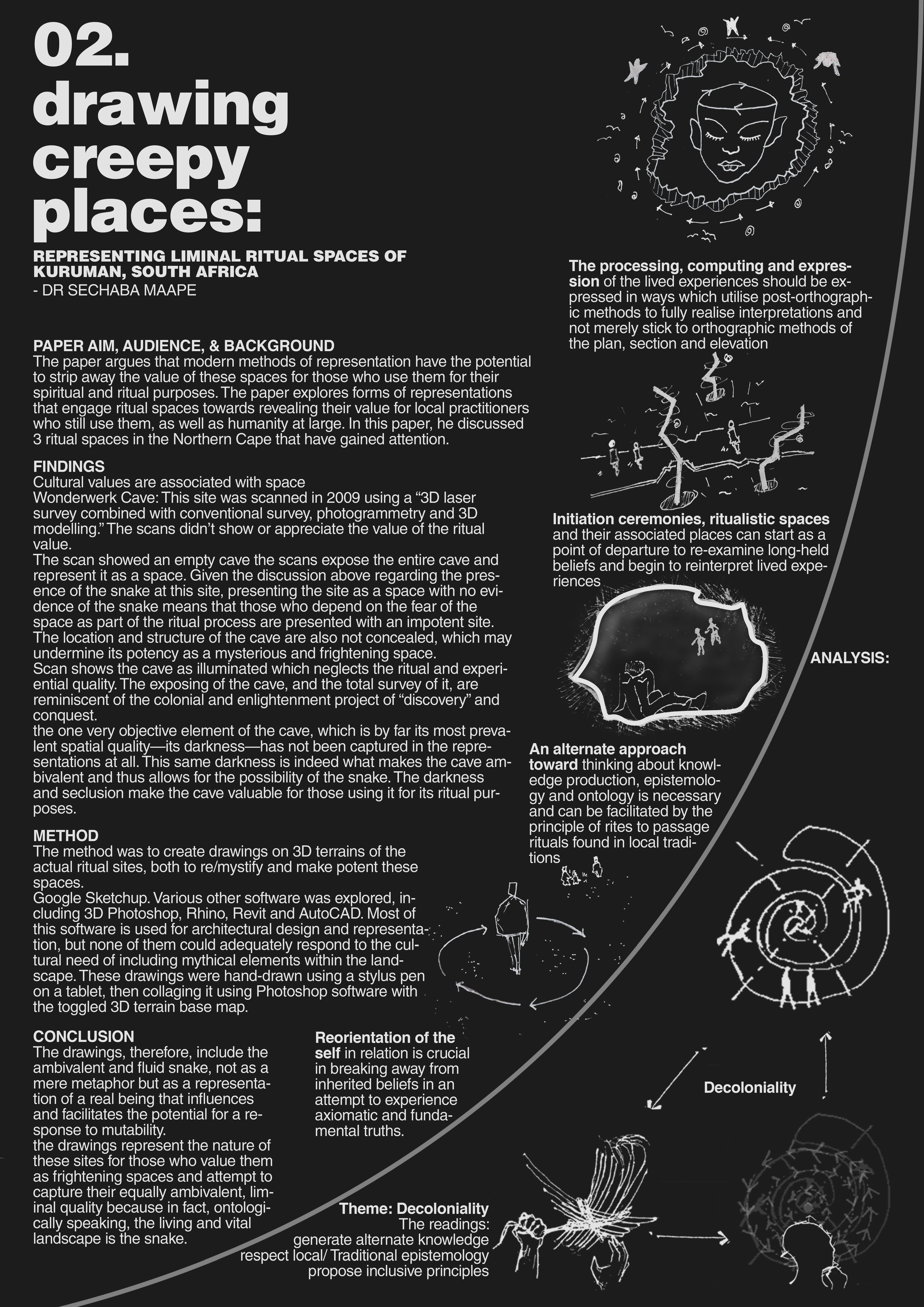
The second piece of literature that we looked at was an arcticle written by Dr Sechaba Maape from Witwatersrand University titled Drawing Creepy Places: Representing liminal ritual spaces of Kuruman, South Africa. The paper argues that modern methods of representation have the potential to strip away the value of spiritual and ritual spaces. In order to demonstrate the value of ritual spaces to the local population and practitioners who still utilise them, the article investigates several representational forms that interact with them.He covered three ritual spaces in the Northern Cape that have drawn interest in this research.
Rituals require a reorientation of the self this is crucial in breaking away from inherited beliefs in an attempt to experience axiomatic and fundamental truths. Maape explores ritual spaces through an architectural lens and uses architectural software such as 3D scanners. The scans didn’t show or appreciate the value of the ritual. The scan showed an empty cave, exposing the entire cave and representing it as an open space.
There is a presence of the snake at this site, presenting the site as a space with no evidence of the snake means that those who depend on the fear of the space as part of the ritual process are presented with an impotent site. The location and structure of the cave are also not concealed, which may undermine its potency as a mysterious and frightening space. Scan shows the cave as illuminated which neglects the ritual and experiential quality.
Therefore Maape used technology such as sketch-up and photoshop and layed over hand drawings to try and accurately represent the liminal spaces. The drawings, therefore, include the ambivalent and fluid snake, not as a mere metaphor but as a representation of a real being that influences and facilitates the potential for a response to mutability. The drawings represent the nature of these sites for those who value them as frightening spaces and attempt to capture their equally ambivalent, liminal quality because ontologically speaking, the living and vital landscape is the snake.
Decolonial Artificial Intelligence
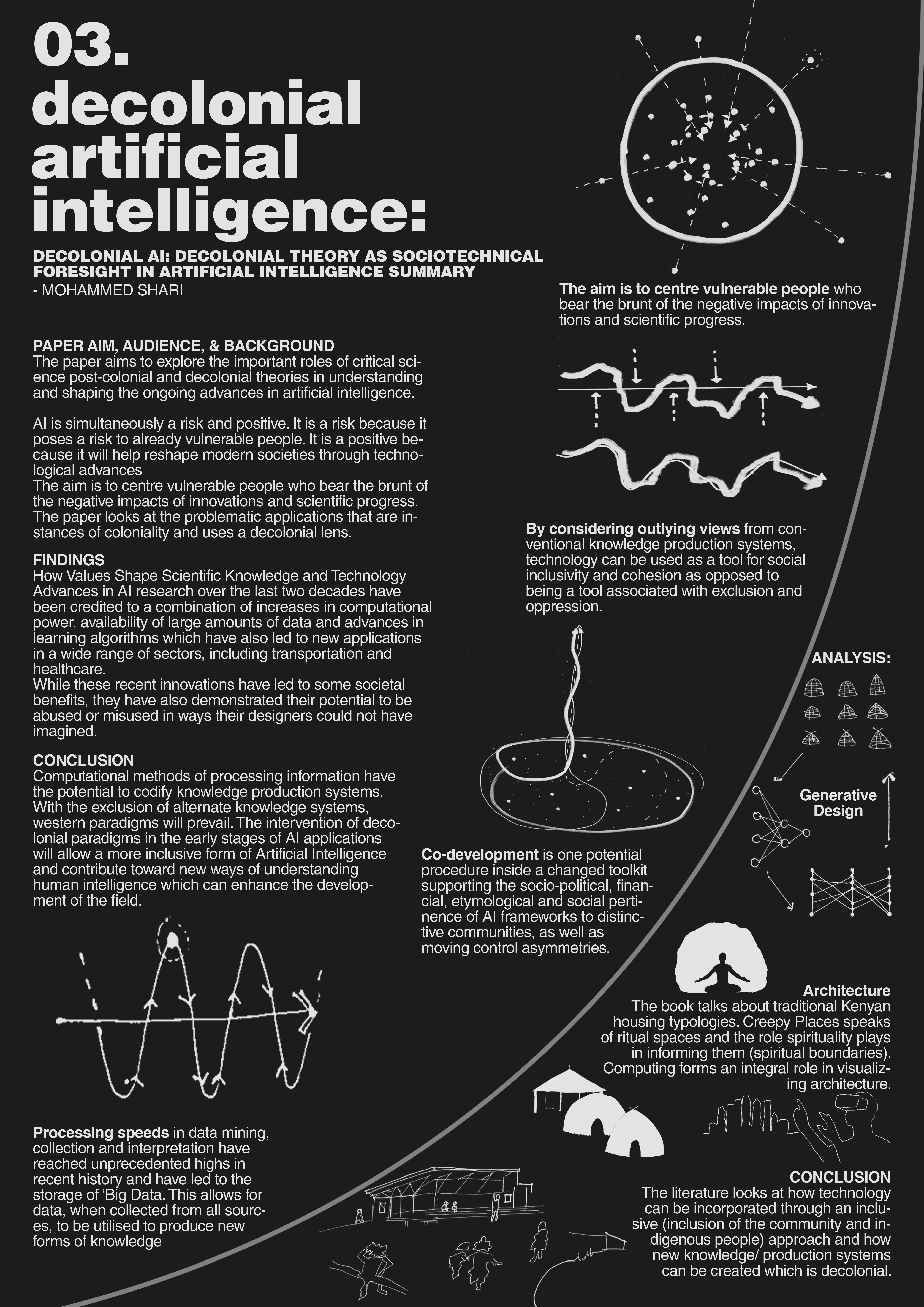
The third and final piece of the literature analysed was a paper by Mohammed Shari titled Decolonial AI: Decolonial Theory as social-technical Foresight in artificial intelligence. This paper aims to examine the significant contributions that postcolonial and decolonial critical science ideas have made to our knowledge of and influence over the development of artificial intelligence.
AI is simultaneously a risk and positive. It is a risk because it poses a risk to already vulnerable people. It is a positive because it will help reshape modern societies through technological advances. The aim is to centre vulnerable people who bear the brunt of the negative impacts of innovations and scientific progress. The paper looks at the problematic applications that are instances of coloniality and uses a decolonial lens.
Therefore, computational methods of processing information have the potential to codify knowledge production systems. With the exclusion of alternate knowledge systems, western paradigms will prevail. The intervention of decolonial paradigms in the early stages of AI applications will allow a more inclusive form of Artificial Intelligence and contribute toward new ways of understanding human intelligence which can enhance the development of the field.
Conclusion
Our findings from our cross-comparative analysis finding are that decoloniality as an attitude can be used in technology which are, construction technology, hand-drawn technology and architectural technology. Construction technology documents people’s ways of thinking and their ways of life. Hand-drawn and architectural technology entails 3D mapping and photo editing software that assist in visual representation.
If one can generate knowledge from these construction and representation methods, then we can start creating new knowledge systems which work in Artificial Intelligence. Currently it is known that generative design and architectural design take inputs from present day architecture and use this to create predictive solutions. Therefore if inputs of African belief systems and construction methods were used in generative design we can actually have an architecture which is actually decolonial and show us what African architecture would look like if we were not colonized.
Written by Kekelwa Akombelwa
 Jus't Spatial Design ZA